
Table of Contents
- What Is Frozen Shoulder and Why Steroid Injection Helps
- How Steroid Injections Work for Frozen Shoulder
- Ultrasound-Guided Shoulder Injection: What to Expect
- Frozen Shoulder Recovery Time After Injection
- Hydrodistension for Frozen Shoulder: When Injection Alone Isn’t Enough
- Physiotherapy for Frozen Shoulder: Your Post-Injection Recovery Plan
- Side Effects, Risks and What You Need to Know Before Treatment
- Is Steroid Injection Right for You? Eligibility and Next Steps
Last Updated: August 10, 2026
What Is Frozen Shoulder and Why Steroid Injection Helps
Frozen shoulder, medically known as adhesive capsulitis, is a condition where the shoulder joint becomes stiff and painful, progressively limiting your range of motion. The glenohumeral joint develops inflammation in the synovial membrane and joint capsule, causing fibrous tissue to form and tighten around the joint. This typically unfolds in three phases: the freezing phase (increasing pain and stiffness), the frozen phase (severe stiffness with reduced pain), and the thawing phase (gradual recovery of movement).
A steroid injection works by reducing synovial inflammation at the source. When corticosteroid medication is delivered directly into the joint space, it suppresses the inflammatory response driving the condition’s progression. This can significantly reduce night pain, improve sleep quality, and restore functional movement faster than physiotherapy alone, particularly when administered early in the freezing phase.
The condition typically affects people aged 40-60 and is more common in women than men. Many patients find that conservative treatments like physiotherapy provide slow improvement over 12-18 months. A steroid injection accelerates this process by addressing the underlying inflammation directly, enabling more effective rehabilitation work.
At MMS Clinic, we’ve seen firsthand how early intervention with steroid injections can shorten the frozen shoulder journey considerably. The key is understanding that injection therapy isn’t a standalone cure, it’s a strategic tool that removes the inflammation barrier, allowing your body and targeted exercises to restore normal shoulder function more efficiently.
How Steroid Injections Work for Frozen Shoulder
Corticosteroid injections reduce inflammation by suppressing the immune response within the joint capsule. When injected into the glenohumeral joint, the medication acts directly on inflamed synovial tissue, reducing pain signals and slowing the formation of restrictive scar tissue.
The mechanism works in several ways. First, corticosteroids inhibit inflammatory cytokines, chemical messengers that trigger pain and tissue swelling. Second, they reduce blood vessel permeability, limiting fluid accumulation in the joint space. Third, they slow fibroblast activity, the cellular process that creates fibrous adhesions.
The anti-inflammatory effect typically begins within 24-48 hours and peaks around 7-14 days post-injection. Most patients experience meaningful pain relief within the first week, with maximum benefit appearing around the two-week mark. This window of reduced inflammation is critical because it allows you to engage more effectively in physiotherapy without pain limiting your movement work.
Steroid injections don’t permanently "cure" frozen shoulder, they interrupt the inflammatory cycle that perpetuates the condition. Your body still needs to remodel the joint capsule and restore normal tissue extensibility. That’s why injection therapy is most effective when combined with structured physiotherapy.
Duration of relief varies considerably. Some patients experience sustained improvement lasting 3-6 months or longer, while others see benefits fade after 6-8 weeks. A minority require a second injection if symptoms plateau. The variability depends on how advanced the adhesions are at injection time, your body’s individual healing response, and the consistency of post-injection rehabilitation work.
Ultrasound-Guided Shoulder Injection: What to Expect
An ultrasound-guided steroid injection for frozen shoulder is a minimally invasive procedure performed under real-time imaging guidance. Unlike blind injections, ultrasound guidance allows the clinician to visualise the needle tip advancing toward the glenohumeral joint space, ensuring accurate placement of medication where inflammation is most active.
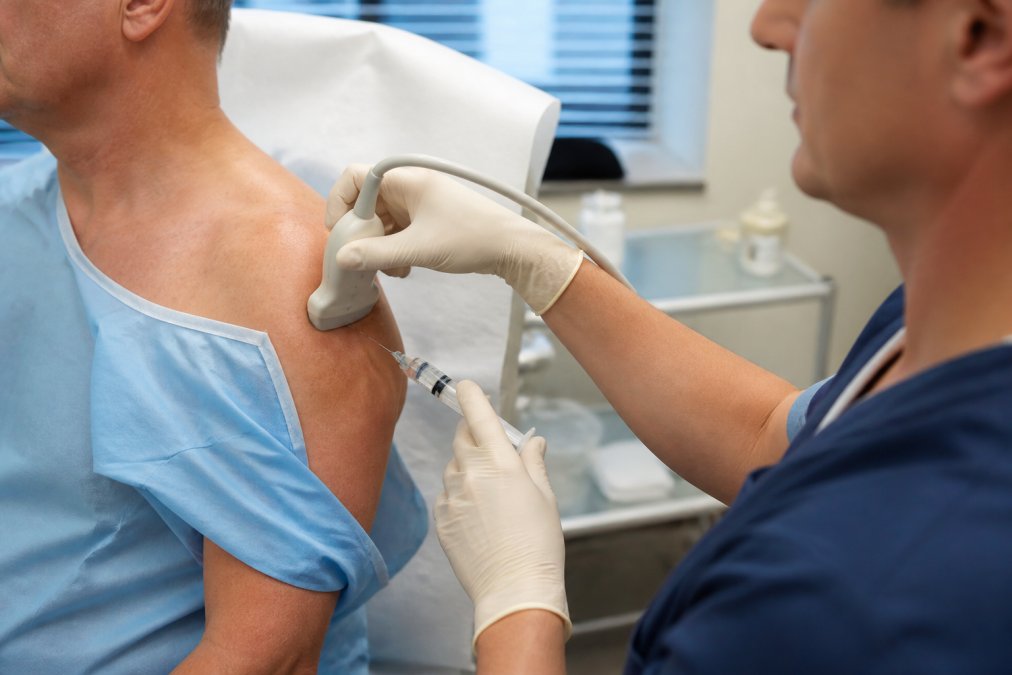
The procedure typically takes 10-15 minutes from start to finish. You’ll be positioned either sitting or lying on your side, with your shoulder exposed and prepped with antiseptic solution. The clinician applies ultrasound gel and positions the probe to visualise the joint capsule. Once the target area is confirmed, a local anaesthetic is applied to numb the skin and deeper tissues.
Most patients describe the sensation as pressure rather than pain, a pushing feeling as the needle advances toward the joint. You may feel a slight catch as the needle passes through the joint capsule, followed by mild pressure as the corticosteroid and local anaesthetic are injected. The entire injection typically takes 30-60 seconds once the needle is positioned.
After the injection, you’ll rest for 10-15 minutes. Some clinics apply ice to reduce post-procedure swelling. Most patients can return to light activity immediately, though strenuous exercise should be avoided for 24-48 hours. You may experience mild soreness or slight stiffness for 24-48 hours as the medication begins to work, this is normal and typically resolves quickly.
Ultrasound guidance offers significant advantages over blind injection technique. Accuracy rates are substantially higher, meaning the medication reaches the intended target consistently. This reduces the risk of missing the joint space entirely or inadvertently injecting into surrounding soft tissue. For frozen shoulder specifically, ultrasound guidance allows visualisation of the joint capsule thickening and confirms needle placement within the synovial space where inflammation is most concentrated.
Frozen Shoulder Recovery Time After Injection
Recovery from a steroid injection for frozen shoulder unfolds in distinct phases, and understanding the timeline helps you set realistic expectations and plan your rehabilitation work appropriately.
The immediate post-injection period (first 24-48 hours) may include mild soreness, slight swelling, or a temporary increase in stiffness. This is a normal inflammatory response to needle trauma and typically resolves within 48 hours.
The active medication phase (days 3-14) is when you’ll notice the most dramatic change. Pain typically reduces significantly by day 3-5, and this reduction often accelerates through day 10-14 as the corticosteroid reaches peak anti-inflammatory effect. Night pain, one of the most disruptive symptoms, often improves within the first week, allowing better sleep and faster recovery overall.
The rehabilitation window (weeks 2-8) is critical. With inflammation reduced, your physiotherapy work becomes far more effective. This is when you should actively engage in range-of-motion exercises, gentle strengthening, and progressive loading.
Sustained improvement phase (weeks 8-12) is when most patients notice meaningful functional gains. Many report returning to normal daily activities, reaching overhead, sleeping on the affected side, and lifting without significant limitation.
The total recovery timeline from frozen shoulder typically spans 12-18 months even with injection therapy. However, injection treatment can compress this substantially. Without intervention, many patients endure 18-24 months of progressive limitation. With early injection combined with consistent physiotherapy, meaningful recovery often occurs within 4-6 months.
Your individual recovery speed depends on several factors: how early in the freezing phase you receive treatment (earlier is better), your age and overall health, the severity of adhesions present, and crucially, your commitment to post-injection physiotherapy.
Hydrodistension for Frozen Shoulder: When Injection Alone Isn’t Enough
Hydrodistension is an advanced technique combining steroid injection with controlled fluid injection to mechanically stretch and mobilise the contracted joint capsule. Where a standard steroid injection delivers medication into the joint space, hydrodistension uses the pressure of injected fluid to physically separate and elongate the fibrous adhesions that restrict movement.
The procedure works by injecting a larger volume of fluid (typically 10-20 ml of saline mixed with corticosteroid and local anaesthetic) into the joint capsule under ultrasound guidance. The increased pressure gently stretches the joint capsule, breaking adhesions and creating space for improved movement.
Hydrodistension is typically reserved for patients who haven’t responded adequately to standard injection therapy alone or who present with advanced, severe stiffness in the frozen phase. It’s particularly effective for patients with very limited external rotation or abduction.
The procedure takes slightly longer than standard injection (15-25 minutes) and may cause more post-procedure soreness due to the mechanical stretching. However, many patients experience more dramatic improvement in range of motion following hydrodistension compared to standard injection, particularly in external rotation.
Recovery follows a similar timeline to standard injection, but the mechanical stretching means you may experience more pronounced post-procedure stiffness for 24-48 hours. Ice application and gentle movement help manage this. Success rates for hydrodistension are higher in earlier phases of frozen shoulder and when combined with consistent physiotherapy.
Physiotherapy for Frozen Shoulder: Your Post-Injection Recovery Plan
Physiotherapy is essential to maximising the benefit of steroid injection. The injection reduces inflammation and pain; physiotherapy restores movement and function. Without targeted exercise work, you risk regaining only partial movement and experiencing symptom recurrence.

The immediate post-injection phase (days 1-7) focuses on gentle, pain-free movement. Your physiotherapist will guide you through passive range-of-motion exercises, movements where gravity or your other arm assists the affected shoulder without active muscle contraction. Pendulum exercises (small circles and swings with the arm relaxed) are particularly effective early on.
The active-assisted phase (weeks 2-4) introduces gentle muscle activation. As pain reduces, you’ll progress to exercises where your muscles assist movement, such as wall slides, gentle internal and external rotation, and assisted reaching. Consistency matters far more than intensity; daily gentle work outperforms occasional aggressive sessions.
The active strengthening phase (weeks 4-8) introduces resistance and progressive loading. Once you’ve restored reasonable pain-free range of motion, you’ll work on strengthening the rotator cuff muscles and scapular stabilisers. Exercises progress from bodyweight movements to light resistance bands to light weights.
Stretching should begin gently in week 2-3 post-injection and progress gradually. Cross-body shoulder stretches, doorway stretches, and sleeper stretches address capsular tightness. Gentle, sustained stretching (30-60 seconds) is more effective than forceful pulling.
The key is consistent home exercise work; most progress comes from daily exercises performed at home, not clinic sessions alone. Common mistakes include stopping physiotherapy too early, exercising too aggressively (which can trigger inflammatory flare-ups), and neglecting strengthening (leading to recurrence months later).
Side Effects, Risks and What You Need to Know Before Treatment
Steroid injections for frozen shoulder are generally safe when administered by experienced clinicians using proper technique. However, like any medical intervention, they carry potential risks that you should understand before proceeding.
Common, minor side effects include temporary post-injection soreness (24-48 hours), mild swelling, or a transient increase in stiffness before improvement begins. These typically resolve without intervention.
Post-injection flare, a temporary increase in pain or stiffness 24-72 hours after injection, occurs in a minority of patients. This usually indicates the injection has triggered a localised inflammatory response as the body processes the medication. Post-injection flare typically resolves within 3-5 days and doesn’t indicate treatment failure.
Potential risks, though uncommon, include infection (extremely rare with proper sterile technique), nerve or blood vessel injury (minimised with ultrasound guidance), allergic reaction to medication (rare but possible), and temporary elevation in blood glucose if you have diabetes.
Repeated corticosteroid injections carry cumulative considerations. Multiple injections to the same joint may increase risk of cartilage damage over time, though this risk is generally low with injections spaced 8-12 weeks apart. Most guidelines recommend limiting steroid injections to 3-4 per joint per year.
Patients with uncontrolled diabetes, active infection, bleeding disorders, or severe osteoporosis should discuss risks carefully with their clinician before proceeding. Pregnancy is generally considered a relative contraindication, though this depends on individual circumstances.
The risk-benefit calculation typically favours injection treatment for frozen shoulder, particularly when conservative therapy alone has proven inadequate. The risks are generally lower than those associated with surgical intervention.
Is Steroid Injection Right for You? Eligibility and Next Steps
Steroid injection for frozen shoulder is most effective for patients in the freezing or early frozen phases, when pain and stiffness are limiting but the condition hasn’t progressed to severe, irreversible adhesions. Ideally, treatment begins within 3-6 months of symptom onset, though benefit is still possible in later phases.
You’re a good candidate if you have:
- Confirmed adhesive capsulitis diagnosis (typically made through clinical examination and imaging)
- Significant pain limiting sleep, daily activities, or work
- Limited range of motion, particularly external rotation or abduction
- Inadequate response to conservative therapy (physiotherapy alone) over 4-8 weeks
- No active infection or uncontrolled systemic disease
- Realistic expectations about outcomes and commitment to post-injection physiotherapy
You may not be suitable if you have:
- Active infection in or around the shoulder joint
- Severe osteoporosis or bone quality concerns
- Uncontrolled diabetes (relative contraindication requiring careful assessment)
- Bleeding disorders or anticoagulant therapy that cannot be safely managed
- Allergy to corticosteroids or local anaesthetics
- Pregnancy (relative contraindication requiring individual assessment)
The next step is a consultation with a clinician experienced in shoulder injection therapy. This should include clinical examination to confirm adhesive capsulitis, discussion of your symptoms and functional limitations, and assessment of whether injection therapy is appropriate for your situation.
At MMS Clinic, our GMC-registered doctors provide thorough consultations, either face-to-face in Coventry or via secure online appointment, to assess your suitability and discuss realistic outcomes. We ensure you understand the procedure, recovery timeline, and the critical role of post-injection physiotherapy before proceeding.
If you’ve experienced frozen shoulder symptoms for several weeks and conservative approaches haven’t delivered meaningful improvement, steroid injection combined with structured physiotherapy offers a proven pathway to faster recovery. The earlier you intervene, the better the outcomes typically are.
Frozen shoulder can be profoundly limiting, but it’s highly treatable when you address inflammation directly and follow through with systematic rehabilitation. A steroid injection removes the inflammatory barrier holding you back; physiotherapy rebuilds your shoulder’s strength and mobility. At MMS Clinic, we combine ultrasound-guided injection technique with expert clinical guidance to ensure you get the best possible outcome. Book a free discovery call to discuss whether injection therapy is right for your situation and start your recovery pathway today.
Frequently Asked Questions
How painful is a steroid injection in the shoulder?
Most patients report minimal discomfort during an ultrasound-guided steroid injection for frozen shoulder. The injection itself lasts seconds, though you may feel pressure as the needle approaches the joint. Local anaesthetic is used to numb the area beforehand. Some soreness or a post-injection flare can occur for 24-48 hours afterwards, but this typically settles quickly. Pain levels vary by individual and injection technique, ultrasound guidance reduces discomfort compared to blind injections.
How often should I get a steroid injection for a frozen shoulder?
Most clinical guidelines recommend a single intra-articular injection as first-line therapy, followed by physiotherapy. If pain relief is inadequate after 4-6 weeks, a second injection may be considered. Repeated steroid injections carry cumulative risks, so doctors typically space them 12 weeks apart and limit them to 3-4 per year maximum. Your GP or orthopaedic specialist will assess your response and determine whether further injections are appropriate based on your symptoms and range of motion improvements.
What is frozen shoulder recovery time after injection?
Most patients experience pain relief within 1-2 weeks of a steroid injection. However, full recovery, restoring shoulder mobility and strength, typically takes 3-6 months when combined with regular physiotherapy. Some improvement in range of motion may be visible within days, but significant functional gains require consistent exercise. Recovery timescale depends on how long you've had frozen shoulder, severity of stiffness, and how diligently you follow your post-injection physiotherapy programme.
Are steroid injections available on the NHS for frozen shoulder?
Yes, steroid injections are available on the NHS for frozen shoulder as part of standard musculoskeletal care, but waiting times can be lengthy, often several months depending on your local integrated care board. Private clinics in the UK offer faster access, typically within days or weeks. Your GP can refer you to NHS orthopaedics or rheumatology, or you can arrange a private consultation with a GMC-registered doctor to discuss injection treatment without waiting lists.
What are the potential side effects of shoulder steroid injections?
Most patients tolerate steroid injections well. Common temporary effects include post-injection flare (increased pain for 24-48 hours), local bruising, and mild swelling. Rare but serious risks include infection, nerve damage, and tendon rupture if the injection is placed incorrectly, which is why ultrasound guidance is recommended. Long-term repeated injections may weaken surrounding tissue. Discuss your full medical history with your doctor beforehand, as certain conditions or medications may affect suitability.
What is the best injection for a frozen shoulder?
A corticosteroid intra-articular injection into the glenohumeral joint is the evidence-based first-line injection treatment for frozen shoulder (adhesive capsulitis). Commonly used agents include triamcinolone or methylprednisolone combined with local anaesthetic. Ultrasound-guided delivery is superior to blind injection because it ensures accurate placement within the joint capsule, improving efficacy and safety. Your orthopaedic specialist will select the specific agent and dose based on your clinical presentation and medical history.
How long does pain relief from a steroid injection last?
Pain relief typically begins within 1-2 weeks and can last 6-12 weeks or longer, though duration varies significantly between individuals. Some patients experience sustained improvement that extends beyond the steroid's pharmacological effect because reduced pain allows them to engage more effectively in physiotherapy, restoring range of motion naturally. If pain returns after 12 weeks, your doctor may discuss repeat injection or alternative treatments. Long-term outcomes depend heavily on consistent physiotherapy during and after the injection window.
This article was written using GrandRanker